Source: Phys.org.
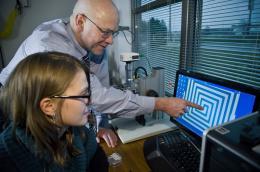
Physics professor Elliott Brown and graduate student Anna Lukawska work in the lab on nanobiological characterizations.
Naturally, DNA sensing and identification has become a very important technology in such areas as biology, medicine and law enforcement. But positive identification without ambiguity is difficult because DNA is so sparse in the human organism and because it shares many of the same chemical bonds as other more common biomolecules–proteins and polysaccharides.
So traditional spectroscopic methods, such as infrared transmission, cannot distinguish DNA from these other molecules. More elaborate techniques are necessary, such as polymerase chain reaction (PCR) followed by gel electrophoresis, which are expensive and time-consuming.
Fortunately, the large size of DNA molecules makes them amenable to other spectroscopic methods in the THz region of the electromagnetic spectrum–a region well below the infrared in frequency but well above common radio and radar frequencies.
Wright State University researchers led by physics professor Elliott Brown have been investigating these unique THz DNA signatures through a Multidisciplinary University Research Initiative (MURI) funded by the U.S. Army Research Office. Their multi-year $600,000 grant has recently identified several unique and surprisingly strong signatures from DNA molecules between 0.7 and 1.0 THz.
“The surprise is that we have recently measured these DNA signatures under physiological conditions in which the DNA was suspended in an aqueous buffer solution very similar to that in living cells,” Brown said. “Previously, the strong THz absorption by liquid water was thought to be too strong to observe signatures from any suspended molecular species.”
So far, Brown said, the signatures appear unique to the DNA molecule at hand, be it single-stranded or double-stranded DNA.
“The caveat is that so far we have only observed relatively short DNA strands well under the length of the human genome,” he said. “But we are moving in that direction.”
The research project is headed by the University of California-Irvine, and along with Wright State University has collaborators at Marshall University, Yale University and the University of Chicago. The MURI Grant funds the research for up to five years.




 news center

 Copyright© 2006-2022 www.thznetwork.org.cn All Rights Reserved