by Ames National Laboratory
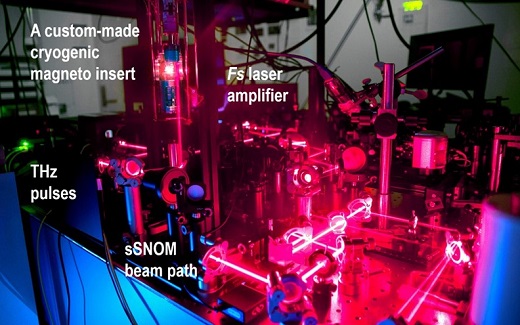
Terahertz microscope with cryogenic insert. Credit: Department of Energy Ames National Laboratory
A team of scientists from the Department of Energy's Ames National Laboratory have developed a way to collect terahertz imaging data on materials under extreme magnetic and cryogenic conditions. They accomplished their work with a new scanning probe microscope.
This microscope was recently developed at Ames Lab. The team used the ultralow temperature terahertz microscope to take measurements on superconductors and topological semimetals. These materialswere were exposed to high magnetic fields and temperatures below liquid helium (below 4.2 Kelvins or -452 degrees Fahrenheit).
According to Jigang Wang, a scientist at Ames Lab, professor of Physics and Astronomy at Iowa State University, and the team leader, the team has been improving their terahertz microscope since it was first completed in 2019. "We have improved the resolution in terms of the space, time and energy," said Wang. "We have also simultaneously improved operation to very low temperatures and high magnetic fields."
To expand their terahertz microscope's capabilities to operate at extreme cryogenic and magnetic environments, Wang explained that his team developed a custom microscopy insert for a cryostat. A cryostat is a device used to maintain extremely cold temperatures. This insert was designed specifically for use with the cryogenic terahertz microscope.
The new microscope capabilities allowed the team to examine superconductors and topological semimetals, both which operate at these low temperatures. These materials can also move electricity with almost zero energy loss and are important for furthering quantum computing technology.
Based on their research so far, Wang said that the microscope could lead to development of new, improved materials for highly coherent quantum devices and a better understanding of superconducting and topological materials.
This research is further discussed in the paper, "A sub-2 Kelvin Cryogenic Magneto-Terahertz Scattering-type Scanning Near-Field Optical Microscope (cm-THz-sSNOM)," published in Review of Scientific Instruments.




 news center

 Copyright© 2006-2022 www.thznetwork.org.cn All Rights Reserved