by Tohoku University
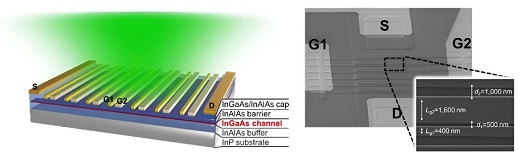
A bird's-eye view of the device structure and electron micrographs of the device surface. G1: gate 1 electrode, G2: gate 2 electrode, D: drain electrode, and S: source electrode. Credit: Akira Satou et al
A research group from Tohoku University and RIKEN has developed a high-speed, high-sensitivity terahertz-wave detector operating at room temperature, paving the way for advancements in the development of next generation 6G/7G technology.
Details of their breakthrough were published in the journal Nanophotonics on November 9, 2023.
The enhancement of current communications speeds will rely on terahertz (THz) waves. THz waves are electromagnetic waves within the THz range, which falls between the microwave and infrared portions of the electromagnetic spectrum, typically spanning frequencies from 300 gigahertz to 3 THz.
Still, the fast and sensitive detection of THz waves at room temperature is challenging for conventional electronic- or photonic-based semiconductor devices.
This is where two-dimensional plasmons come in. In a semiconductor field-effect transistor, there is a two-dimensional electron channel where a collective charge-density quanta, i.e., two-dimensional plasmons, exist. These plasmons are excited states of electrons exhibiting fluid-like behaviors. Their nonlinear rectification effects, originating from these fluid-like behaviors, and their rapid response (not constrained by electron transit time) make them a promising means to detect THz waves at room temperature.
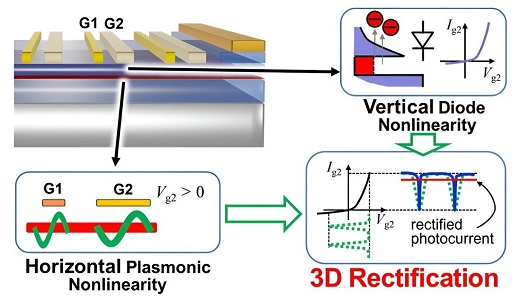
Schematic view of the 3D rectification effect in the device. Credit: Akira Satou et al
"We discovered a 3D plasmonic rectification effect in THz wave detector," says Akira Satou, leader of the research group and associate professor at Tohoku University's Research Institute for Electrical Communication (RIEC). "The detector was based on an indium-phosphide high-electron mobility transistor and it enabled us to enhance the detection sensitivity more than one order of magnitude higher than conventional detectors based on 2D plasmons."
The new detection method combined the traditional vertical hydrodynamic nonlinear rectification effect of 2D plasmons with the addition of a vertical diode-current nonlinearity.
It also dramatically resolved the waveform distortion caused by multiple reflections of high-speed modulated signals—a critical issue in conventional detectors based on 2D plasmons.
Leading the group alongside Satou was Specially Appointed Professor Tetsuya Suemitsu from Tohoku University's New Industry Creation Hatchery Center and Hiroaki Minamide from RIKEN Center for Advanced Photonics.
"Our new detection mechanism overcomes most of the bottlenecks in conventional terahertz-wave detectors," adds Satou. "Looking ahead, we hope to build on our achievement by improving the device performance."




 news center

 Copyright© 2006-2022 www.thznetwork.org.cn All Rights Reserved