Source: optics.org.
Nanostructured gold films can be used as effective broadband terahertz antireflection coatings, say scientists in Germany.
Andreas Thoman and colleagues at the University of Freiburg have shown that nanostructured gold can almost entirely suppress reflections at the substrate-to-air interface over frequencies ranging from 200?GHz to 2.2?THz in the far infrared. To date, such zero reflection has only been achieved for specific frequencies using conventional methods.
The researchers used the concept of “impedance matching”: previous work has shown that ultrathin metallic coatings suppress reflections of electromagnetic radiation over a much broader bandwidth than conventional dielectric antireflection coatings. However, the bandwidth of the coating was limited by the frequency-dependent properties of the bulk metal films employed in these earlier experiments. (Phys. Rev. B 77 195405)
Now, the Freiburg researchers have overcome this problem by using a discontinued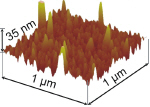 gold film that has a different conductivity than bulk gold thanks to its nanostructure. “It turns out that the characteristic behaviour of the nanostructured film allows us to achieve nearly perfect impedance matching over a very broad frequency range,” Thoman told nanotechweb.org.
The team made its nanostructured coating using a chemical deposition technique called electroless plating. They dropped a liquid solution containing gold ions onto a silicon substrate. A gold nanostructure was formed in a chemical reaction. The technique is inexpensive and can be used to coat relatively large, square centimetre areas of substrate.
The scientists also showed that – in principle – other coating techniques, such as cluster deposition, can be employed to create nanostructured films that work as antireflection coatings. Nanostructured gold film surface analysis
“Our nanocoatings can be used to coat optical components for the far infrared, such as lenses, substrate windows and beam splitters to suppress unwanted internal reflections,” explained Thoman.
The researchers now plan to investigate how the terahertz antireflection properties of their nanostructured films vary with temperature. “This might help us fine-tune the performance of the coating,” said Thoman. “Of course, we then want to coat active terahertz devices and test their performance.”




 news center

 Copyright© 2006-2022 www.thznetwork.org.cn All Rights Reserved