Source: optics.org
Team led by Bochum's Martina Havenith develops new method to measure real time heat and energy changes at protein-solvent interface.
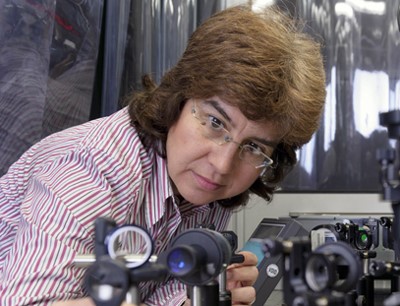
Prof Dr Martina Havenith from the Ruhr-Universität Bochum (RUB)
The European Research Council (ERC) is to finance a research team led by Prof Dr Martina Havenith from the Ruhr-Universität Bochum (RUB) with �2.5 million over five years to develop an optical procedure to investigate the behavior of proteins in biochemical reactions.
In a process called time-resolved terahertz calorimetry, the RUB scientists say they will ^tinker with terahertz laser spectroscopy to deduce with nanosecond precision how proteins and solvent exchange energy and rearrange themselves in biological processes ̄.
Professor Havenith, who is Chair of the Department of Physical Chemistry II at RUB and speaker for the cluster of known as European Research Council (^Resolv ̄), will lead an international team with Prof Dr Irit Sagi from the Weizmann-Institute in Israel and Dr Matthias Heyden from the Max-Planck-Institute for Coal Research in M┨lheim at the Ruhr, Germany.
¨Underestimated role of water¨
Fundamental biological processes such as protein folding, protein-protein interactions and enzymatic reactions take place in watery solutions and depend upon the ability of the reacting molecules to recognize themselves in a solvent. Molecular recognition is mediated through various chemical interactions that can be studied by calorimetry, measuring enthalpy, entropy d other associated energetic parameters.
Unfortunately, current calorimetric approaches are all based on heat transfer, hence they deliver results on time scales of 1 to 100 seconds and can analyze the system only at equilibrium, that is when molecules are already bound. However, as Havenith points out, a successful reaction is the result of a dynamic interplay between the partner molecules and the solvent. "Terahertz-Calorimetry promises to investigate these processes, for the first time in real time with a million time better time resolution," the scientists claim.
The new technique will use terahertz light sources to excite solvent molecules and biomolecules at the time scales of hydrogen bond dynamics in water as well as large-amplitude motions of proteins and nucleic acids. ^If we are able to collect full information on these time-scale dynamics, we can deduce useful values of entropy, enthalpy, and so on associated with molecular recognition processes ̄, said Havenith.
Time-resolved terehaertz calorimetry will also offer, the opportunity to directly access the distinct contributions of the solute entropy changes versus those of the solvent. To this end, the Bochum-based project will combine the expertise gathered in terahertz laser development with microwave technology, biophysics, calorimetry and theoretical modeling. ^Interdisciplinary discussions within Resolv were crucial to inspire us the THz calorimetry idea ̄, added Havenith.
Two grants
In the latest application round for the ERC's Advanced Grants, two further researchers from the Ruhr-Universität Bochum have been successful: IT security expert Prof Dr Christof Paar also raised such a grant. Via these two projects, the RUB will receive up �5 million in total.
The European Union launched the European Research Council in 2007 to fund excellent research in Europe. The ERC Advanced Grants program targets senior researchers with ground-breaking ideas that may be risky to pursue, awarding up to �2.5 million for five years. The 2015 call received almost 2000 project applications from 29 countries, but only about 14% of them were selected after a peer review process. ^I received the confirmation message at Z┨rich airport after an 11-hour flight. I had to read it three times before I believed it. It is such a great chance to test some exciting new ideas ̄, said Havenith.




 news center

 Copyright© 2006-2022 www.thznetwork.org.cn All Rights Reserved