Source: optics.org
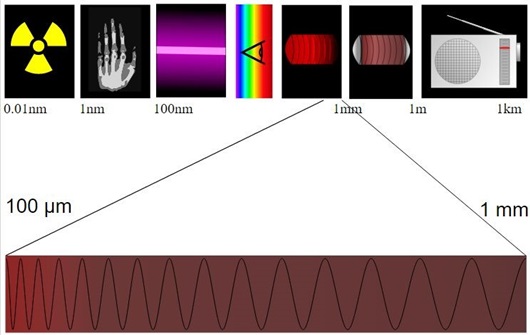
Terahertz waves lie at the far end of the infrared band, just before the start of the microwave band. Credit: Wikipedia/CC BY-SA 3.0
An Osaka University research team has introduced a new terahertz detector that allows extremely rapid wireless data communication and highly sensitive radar by using a frequency range that has previously been very difficult to work with. Their approach combined sensitive electronics and a novel method for handling high frequencies to achieve the long-sought goal of using terahertz radiation for sending and receiving wireless data. The record 30 gigabit per second real-time error-free transmission they obtained may lead the way for next-generation (6G) cellular network technology.
Wireless data is in great demand. Not only do mobile phones need high speeds to stream videos on the go, but some people living in rural areas rely entirely on wireless for their home broadband connections. Terahertz radiation—electromagnetic waveswith frequencies around 1012 cycles per second—has long been tempting scientists and cell phone companies alike. The high frequency of terahertz radiation would allow more data to be transmitted per second, compared with the current standard of about 800 MHz. However, a practical terahertz receiver has remained elusive, for two main reasons. First, the electromagnetic oscillations are just too fast for conventional electronics to handle, and both the terahertz oscillator and detector have poor efficiency. Second, the thermal noise of the room-temperature detector obscures the received signals above.
Now, researchers at Osaka University have invented a novel receiver that not only overcomes these obstacles, it also set the record for the fastest error-free real-time transmission speed to date. They used a special electronic component called a resonant tunneling diode. In contrast with normal electronics—for which the current always increases at larger voltages—in a resonant tunneling diode, there is a specific "resonant" voltage that yields the peak current. Thus, there exists a region in which the current actually falls with increasing voltage. This nonlinear behavior allows the scientists to synchronize the rapid received terahertz signals with an internal electronic oscillator in the device, and then separate the data from the carrier wave. In the end, the sensitivity was enhanced by a factor of 10,000. "Among all electronic-based systems, ours achieved the highest error-free wireless transmission data rate," says first author Yousuke Nishida.
Cell phone towers are not the only places you might find terahertz radiation in the future. "This technology can be put to work in a wide range of applications, in addition to next-generation 6G wireless communication. These include spectroscopic sensing, non-destructive inspection, and high-resolution radar," adds corresponding author Masayuki Fujita.




 news center

 Copyright© 2006-2022 www.thznetwork.org.cn All Rights Reserved