by Linköping University
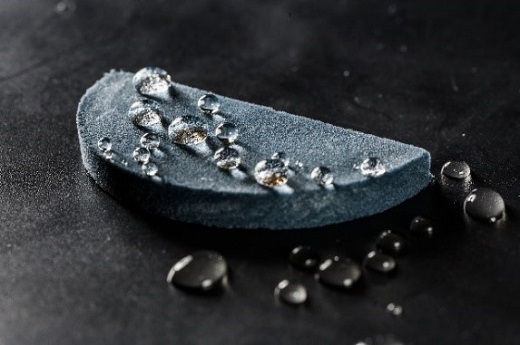
Aerogel can obtain high hydrophobicity by simple chemical modifications. Credit: Thor Balkhed
High-frequency terahertz waves have great potential for a number of applications including next-generation medical imaging and communication. Researchers at Linköping University, Sweden, have shown, in a study published in the journal Advanced Science, that the transmission of terahertz light through an aerogel made of cellulose and a conducting polymer can be tuned. This is an important step to unlock more applications for terahertz waves.
The terahertz range covers wavelengths that lie between microwaves and infrared light on the electromagnetic spectrum. It has a very high frequency. Thanks to this, many researchers believe that the terahertz range has great potential for use in space exploration, security technology and communication systems, among other things.
In medical imaging, it can also be an interesting substitute for X-ray examinations as the waves can pass through most non-conductive materials without damaging any tissue.
However, there are several technological barriers to overcome before terahertz signals can be widely used. For example, it is difficult to create terahertz radiation in an efficient way and materials that can receive and adjust the transmission of terahertz waves are needed.
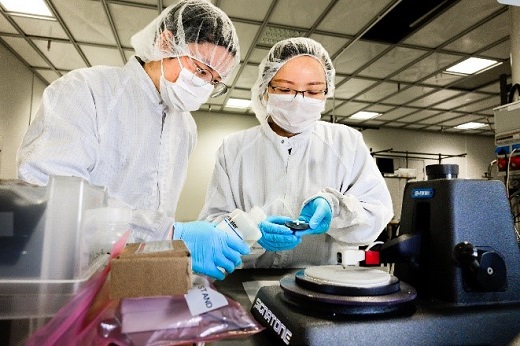
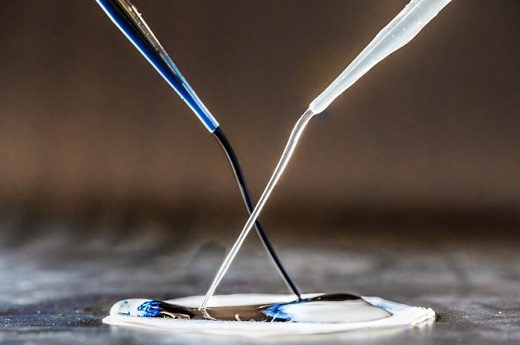
Qilun Zhang and Chaoyang Kuang, researchers at the Laboratory of Organic Electronics. Credit: Thor Balkhed
Researchers at Linköping University have now developed a material whose absorption of terahertz signals can be turned on and off through a redox reaction. The material is an aerogel, which is one of the world's lightest solid materials.
"It's like an adjustable filter for terahertz light. In one state, the electromagnetic signal will not be absorbed and in the other state it can. That property can be useful for long-range signals from space or radar signals," says Shangzhi Chen, postdoc at the Laboratory of Organic Electronics, LOE, at Linköping University.
The Linköping researchers used a conducting polymer, PEDOT:PSS, and cellulose to create their aerogel. They also designed the aerogel with outdoor applications in mind. It is both water-repellent (hydrophobic) and can be naturally defrosted via heating by sunlight.
Conducting polymers have many advantages over other materials used to create tunable materials. Among other things, they are biocompatible, durable, and have a great ability to be tuned. The tunability comes from the ability to change the charge density in the material. The great advantages of cellulose are the relatively low production cost compared to other similar materials and that it is a renewable material which is key for sustainable applications.
"The transmission of terahertz waves in a broad frequency range could be regulated between around 13 % and 91 %, which is a very large modulation range," says Chaoyang Kuang, postdoc at LOE.




 news center

 Copyright© 2006-2022 www.thznetwork.org.cn All Rights Reserved