by SPIE
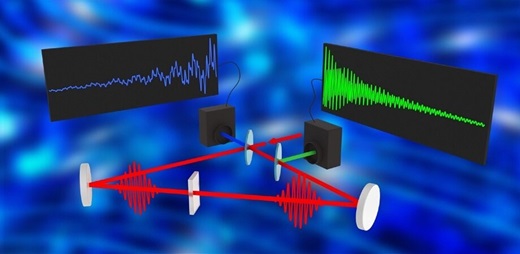
Sagnac interferometry and optical filtering come together to provide dual-region (THz–fingerprint) Raman spectral sensitivity at 24,000 spectra/s. Credit: Walker Peterson, University of Tokyo.
Raman spectroscopy offers a powerful approach to chemical measurement. By directly probing molecular vibrations, it obtains chemical specificity without the need for chemical labels. Thanks to these virtues, it has become an indispensable tool in a diverse range of fields, including materials science, biology, pharmaceuticals, and food science.
Broadband Raman vibrational spectra are commonly segmented into three distinct spectral regions: terahertz (THz), or low-frequency (<200 cm-1; <6 THz); "fingerprint" (200 to 1,800 cm-1); and high-frequency (2,400 to 4,000 cm-1). While the fingerprint region derives its name from its target-specific intramolecular bond vibrations, the THz region can provide chemical structural information via intermolecular vibrations. The complementary nature of these two regions makes their marriage a powerful tool for chemical analysis.
Despite the rich information provided by broadband THz–fingerprint Raman spectra, existing methods to obtain them typically have low real-time spectral acquisition rates (generally, <10 spectra/sec), which manifests as coarse experimental temporal resolution. Although several research groups have pushed broadband Raman spectral acquisition rates to impressive levels (on the order of 10,000 to 100,000 spectra/sec), the methods tend to be limited to detection of either the THz or fingerprint regions alone. These limitations pose a barrier to investigating short-lived irreversible phenomena at the molecular bond and structural level.
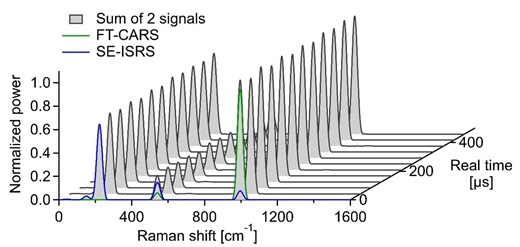
DIVS enables THz–fingerprint Raman spectra (gray trace) at an ultrafast real-time spectral acquisition rate of 24,000 spectra/sec. The key novelty of the method is the simultaneous detection of two complementary Raman signals: SE-ISRS (THz region-sensitive, blue trace) and FT-CARS (fingerprint region-sensitive, green trace). Credit: Advanced Photonics (2022). DOI: 10.1117/1.AP.4.1.016003
As reported in Advanced Photonics, researchers at the University of Tokyo recently overcame these limits by developing a method for broadband THz–fingerprint Raman spectroscopy at an ultrafast spectral rate of 24,000 spectra/sec. The new technique, named "dual-detection impulsive vibrational spectroscopy" (DIVS), enables synchronous measurement of two distinct types of vibrational signals, which provide dual-region sensitivity when detected in concert.
More technically, DIVS blends optical longpass and shortpass filtering with common-path Sagnac interferometry to simultaneously detect frequency-shifted laser pulses ("FT-CARS," fingerprint-sensitive) and phase delay-shifted pulses ("SE-ISRS," THz-sensitive). Moreover, the DIVS setup is straightforward and requires only a single laser.
The researchers performed DIVS proof-of-concept measurements of several transparent liquid compounds over the Raman spectral range of 66 cm-1 (2.0 THz) to 1,211-cm-1. The strongest signature vibrational peaks in single Raman power spectra (acquired in <42 μs) were demonstrated with high signal-to-noise ratios of >1000. At the current stage, DIVS is recommended for studying high-concentration transparent samples, though modifications of the design could possibly overcome these boundaries.
This work holds potential for interesting real-time broadband THz–fingerprint Raman measurements at sub-millisecond temporal resolutions. One promising direction for DIVS applications is in polymer science. In addition to signature molecular bond vibrations in the fingerprint region, polymers are known to exhibit rich structural information in the THz region. Ultrafast DIVS could be well-suited to understanding rapid polymerization systems at the molecular level.




 news center

 Copyright© 2006-2022 www.thznetwork.org.cn All Rights Reserved